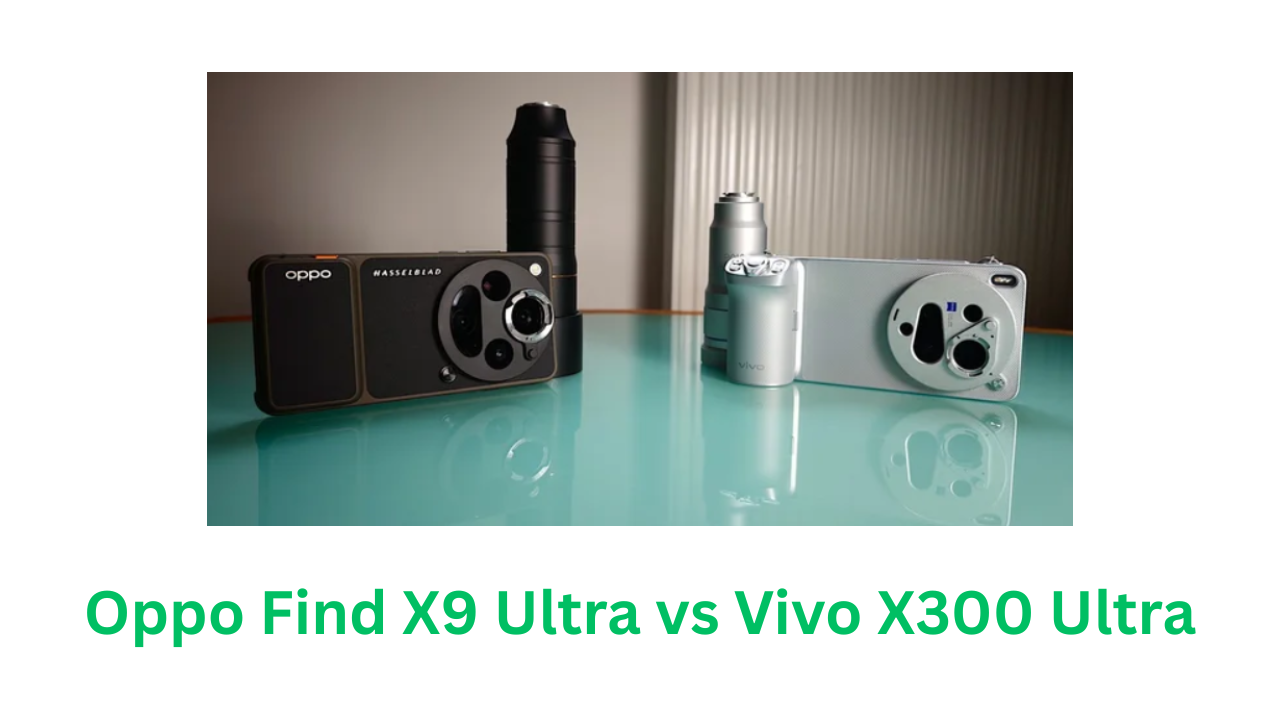
If you have been following the smartphone camera race in 2026, you already know that two devices have emerged as the most talked-about flagships of the year: the Oppo Find X9 Ultra and the Vivo X300 Ultra. Both phones are extraordinary pieces of engineering.
Both arrive with detachable telephoto lens accessories, partnerships with legendary camera brands, and a shared ambition to replace your dedicated camera entirely.
But here is the thing — despite sharing so much DNA, these two phones are built for very different kinds of people. One is a dream machine for photographers. The other is a serious tool for videographers and content creators.
Spending extended time with both devices across a wide range of real-world shooting scenarios makes that distinction abundantly clear.
So which one should you actually buy? Let us break it down, category by category, with an honest opinion on where each phone wins, loses, and surprises.
Quick Overview: What Are These Phones?
Before getting into the details, here is a brief summary of what each phone brings to the table.
The Oppo Find X9 Ultra is Oppo’s most premium flagship, built around a penta-camera system and powered by the Snapdragon 8 Elite Gen 5 processor.
Its partnership with Hasselblad influences both the hardware design and the camera software, particularly a dedicated shooting mode that prioritises optical authenticity over computational trickery.
The headline feature is a built-in 10x optical zoom telephoto camera — an incredibly rare capability that sets it apart from nearly every other smartphone on the market.
The Vivo X300 Ultra arrives as Vivo’s most ambitious phone yet, leaning heavily on its Zeiss partnership for lens quality and colour science.
It positions itself as a professional-grade video device as much as a photography powerhouse, with video codecs and stabilisation technology that would not look out of place in a small production studio.
Its built-in zoom tops out at 3.7x, but a pair of Zeiss-tuned teleconverter lenses push the system to an extraordinary maximum of 17x optical zoom.
Both phones cost a significant amount of money. Both are primarily available in select global markets. And both will genuinely impress anyone who picks them up. The question is which one impresses you — for the way you actually shoot.
Camera Hardware: How Do They Stack Up?
Oppo Find X9 Ultra — A Zoom Photographer’s Playground
The Find X9 Ultra is, first and foremost, a zoom-centric device. Its main camera uses a 200-megapixel sensor with a large 1/1.28-inch physical size and a very wide f/1.5 aperture.
That aperture figure matters a great deal — it means the lens can pull in significantly more light than narrower alternatives, which translates to better performance when the sun goes down or when you are shooting in tricky indoor conditions.
What makes the Find X9 Ultra genuinely special, however, is its dual telephoto setup. The first telephoto is a 200MP camera capable of 3x optical zoom — an excellent portrait-length focal length that works beautifully for people, food, and close-up detail shots.
The second telephoto is where Oppo has done something remarkable: a 50MP sensor with a true 10x optical zoom capability. This kind of reach, without any digital cropping, is extraordinarily rare in the smartphone world.
It means you can photograph subjects far in the distance — birds, architecture, distant faces in a crowd — with a level of optical clarity that would previously have required a large telephoto lens and a dedicated camera body.
Even before attaching any accessory lenses, the Find X9 Ultra offers 20x lossless zoom, achieved by combining optical and sensor cropping on its high-resolution telephoto.
Round out the system with a 50MP ultrawide and a 3.2MP multispectral sensor that helps with white balance and colour accuracy, and you have one of the most versatile built-in camera arrays ever assembled in a smartphone.
Vivo X300 Ultra — Bigger Sensor, Broader Ambition
The Vivo X300 Ultra takes a different approach. Its main 200MP camera sits behind a slightly smaller maximum aperture of f/1.85, but the sensor itself is physically larger at 1/1.12 inches.
A bigger sensor captures more light per pixel and generally produces images with greater dynamic range and a more natural, film-like quality.
The 35mm focal length of the main camera also gives it a more cinematic perspective compared to the wider field of view favoured by many competing flagship phones.
Where the X300 Ultra stunned during testing is its ultrawide camera — a lens that most manufacturers treat as an afterthought but Vivo has elevated to something genuinely impressive, more on that shortly.
Its primary telephoto camera maxes out at 3.7x optical zoom, which is a noticeable limitation compared to the Find X9 Ultra’s built-in 10x. For users who want serious reach without attaching accessories, the X300 Ultra falls short of its rival.
That said, Vivo’s overall sensor engineering is meticulous. The consistent colour rendering across all three cameras — main, ultrawide, and telephoto — is among the best available in a smartphone.
Switching between focal lengths does not produce the jarring colour or exposure shifts that still plague many competing devices.
The Ultrawide Camera: Vivo’s Surprising Advantage
Most smartphone ultrawide cameras are, frankly, disappointing. They exist to add a third camera listing to a spec sheet, and manufacturers often pair them with small sensors, cheap glass, and no stabilisation.
Vivo has decided to treat the ultrawide lens as a first-class citizen on the X300 Ultra, and the results are genuinely impressive.
The X300 Ultra’s ultrawide uses a 50MP sensor with a physical size of 1/1.28 inches — nearly twice the area of the Find X9 Ultra’s ultrawide sensor at 1/1.95 inches. More importantly, Vivo has included optical image stabilisation on this camera, which is genuinely rare for an ultrawide focal length.
The combination of a large sensor, OIS, and Zeiss anti-reflective lens coating produces ultrawide shots that are sharp from edge to edge, low in lens flare, and rich in detail even in challenging light.
The Find X9 Ultra’s ultrawide camera is not bad by any means. Its 50MP sensor and f/2.0 aperture deliver competent results. But placed side by side with the Vivo’s ultrawide output, the difference is evident.
The Oppo images show more lens flare around bright light sources, slightly softer edges, and a touch less overall detail. For landscape photographers, travel shooters, and anyone who regularly reaches for the widest focal length, the X300 Ultra’s ultrawide is the better tool.
Winner: Vivo X300 Ultra — by a clear margin.
Telephoto and Teleconverter Performance: Oppo Fights Back
This is where the Find X9 Ultra reasserts itself and makes a compelling case for the zoom-focused photographer.
Out of the box, the comparison is one-sided: 10x optical zoom versus 3.7x is not a contest. The Find X9 Ultra wins that round without breaking a sweat. But the real competition happens when you add the teleconverter accessories that both companies include in their premium camera kits.
Vivo’s teleconverter system offers two lens options: a 200mm piece that brings the X300 Ultra to approximately 8.7x zoom, and a 400mm option that pushes the total reach to around 17x optical zoom — the furthest of any smartphone camera system currently available.
On paper, this is extraordinary. In practice, the experience is more complicated.
At maximum zoom with the 400mm lens attached, the X300 Ultra’s gimbal stabilisation system struggles to compensate for hand movement. Blur and camera shake become real issues unless the phone is mounted on a tripod.
Low-light performance with the teleconverter attached also drops noticeably, producing images that often look muddy and lack the detail that the system promises.
Oppo’s 300mm Explorer teleconverter is a more measured proposition. It brings the Find X9 Ultra to 13x optical zoom by routing the image through the phone’s larger 200MP 3x telephoto sensor rather than the narrower 10x camera.
This approach preserves more image quality because the sensor involved is physically larger, and the effective aperture, while reduced by the added glass, remains more workable than the Vivo’s equivalent.
The camera grip included in Oppo’s kit — with its two-stage shutter button and zoom rocker — also makes the whole experience feel significantly more like using a proper camera.
In real-world testing across varied conditions, the Find X9 Ultra’s teleconverter system produces more consistently usable results. It may not reach 17x, but 13x of high-quality optical zoom with better stability and better low-light performance is a more practical tool for most photographers.
Winner: Oppo Find X9 Ultra — for real-world usability and consistency.
Camera Software: Two Very Different Philosophies
Hardware tells only part of the story. How a phone processes its images — the software decisions made after the shutter fires — shapes the final result just as much as the lens and sensor.
Oppo’s Hasselblad Master Mode: Honesty Over Flattery
Oppo’s collaboration with Hasselblad has produced one of the most thoughtful software features in mobile photography: Master Mode.
When activated, this mode disables most of the phone’s computational image processing — the AI sharpening, the automatic HDR boosting, the digital skin smoothing that makes portraits look eerily perfect.
The result is images that look more like photographs and less like processed simulations. Edges are rendered as the lens actually captured them. Colours reflect what was actually in front of the camera.
Faces look like human beings rather than slightly idealised versions of themselves. This matters more in telephoto photography than almost anywhere else, because aggressive AI processing at long focal lengths produces some of the worst artefacts in smartphone photography: ghostly halos, scrambled fine text, and unnaturally sharp edges that look painted rather than optical.
The trade-off is real — low-light performance in Master Mode is weaker than in the standard AI-assisted mode, because you are relying entirely on optical performance.
But for photographers who value accuracy and authenticity, Master Mode is worth that trade. It is one of the most honest things a smartphone camera software has ever offered.
Vivo’s Zeiss Colour Science: Consistency Across the Board
Vivo’s approach with the X300 Ultra prioritises colour consistency above all else. The Zeiss Natural Colour mode produces images with realistic, measured tones that hold up beautifully when brought into a photo editing application.
The consistency between cameras — so that a scene photographed at 1x, ultrawide, and 3.7x all shows matching colours and exposure — is remarkably good.
The downside is that Vivo offers no equivalent of Master Mode. The AI processing on the telephoto camera can still produce over-sharpened results in certain conditions, and there is no simple switch to step around it.
For photographers who want full creative control over how the phone renders an image, the Find X9 Ultra’s software approach is more satisfying.
Video: Vivo X300 Ultra Is in a League of Its Own
If video is your priority, the conversation becomes straightforward: the Vivo X300 Ultra is significantly better, and it is not particularly close.
Vivo has built the X300 Ultra as a device that professional and semi-professional video creators can genuinely use on paid productions. The headline capability is support for the APV 422 codec, which records at 4:2:2 chroma subsampling.
Most smartphones record at 4:2:0, which discards half of the colour information in order to save storage space. The 4:2:2 format preserves that colour data, resulting in footage that grades more cleanly, holds up better in post-production, and can sit alongside footage from professional cinema cameras without extensive correction work.
All three cameras on the X300 Ultra support 4K recording at 120 frames per second in 10-bit log format. Combined with Academy Color Encoding System support, the phone is ready to be dropped into a professional editing pipeline with minimal fuss.
Perhaps most impressively for working videographers, the X300 Ultra supports custom 3D LUT previews during live recording — meaning that when shooting in a log format, you can see a graded preview of how the footage will ultimately look, rather than the flat, washed-out image that log recording typically shows.
This is a feature borrowed from professional cinema cameras, and its inclusion on a smartphone is genuinely remarkable.
Stabilisation during video is equally impressive. The X300 Ultra uses electromagnetic motors to physically move the entire lens-and-sensor assembly, compensating for up to seven stops of camera movement.
Walking shots look smooth. Handheld pans hold steady. The horizon-lock mode, which keeps the horizon level regardless of how much the phone tilts, is the kind of feature usually found only in action cameras.
The Find X9 Ultra supports ACES and includes Hasselblad-branded video filters, but it lacks the APV 422 codec, the LUT preview feature, and falls behind on stabilisation.
In lower light and during movement, the Find X9 Ultra’s video shows a pulsing, pixelated quality as its stabilisation system reaches its limits. For serious video work, it simply cannot match the X300 Ultra.
Winner: Vivo X300 Ultra — and it is not debatable.
Hardware, Battery, and Display
Both phones use the Snapdragon 8 Elite Gen 5 processor, which means performance is essentially identical and excellent across the board. Daily use, gaming, and heavy camera workloads are all handled without hesitation.
Display-wise, both phones run 6.8-inch LTPO AMOLED panels at the same resolution with adaptive refresh rates between 1Hz and 120Hz.
The Find X9 Ultra can reach 144Hz for supported games — a minor but real advantage for mobile gaming enthusiasts. Peak brightness favours the X300 Ultra at 4,500 nits compared to 3,600 nits, though in most real-world conditions both displays look exceptional.
Battery life goes to Oppo. The Find X9 Ultra carries a 7,050mAh Silicon Carbon battery against the X300 Ultra’s 6,600mAh. In extended testing, the Find X9 Ultra delivered approximately 39 hours of video playback to the X300 Ultra’s 36 hours.
Both figures are impressive — comfortably ahead of most competing flagships. Both phones support 100W wired charging, which gets either device back to full capacity quickly.
One small but meaningful hardware detail: the Find X9 Ultra includes a dedicated capacitive camera button on the right edge of the device, similar to the approach Apple uses on the iPhone 17 series.
It makes launching the camera and taking shots feel more tactile and natural. The X300 Ultra includes no camera button at all, which is a genuinely puzzling omission on a phone that markets itself to serious photographers and videographers.
Pricing: Which Offers Better Value?
| Configuration | Approx. Price (USD) |
|---|---|
| Oppo Find X9 Ultra (phone only) | ~$1,673 |
| Oppo Find X9 Ultra + Camera Kit | ~$2,250 |
| Vivo X300 Ultra (phone only) | ~$2,023 |
| Vivo X300 Ultra + Camera Kit (two lenses) | ~$2,700 |
| Vivo X300 Ultra Full Pro Bundle | ~$3,200+ |
The Oppo Find X9 Ultra offers considerably better value. At roughly $350 less for the phone alone, and with a built-in 10x optical zoom that negates the immediate need for a teleconverter accessory, you get a huge amount of photographic capability for less money.
The Vivo X300 Ultra’s phone-only price is notably higher, and genuinely unlocking the system’s full potential requires spending significantly more on the complete camera kit.
Availability is also a consideration. The Find X9 Ultra has confirmed UK and select global market availability.
The Vivo X300 Ultra, despite being described as a global launch, remains difficult to source in many Western markets and may require importing through grey market channels — adding cost, removing warranty protections, and complicating software updates.
Who Should Buy the Oppo Find X9 Ultra?
The Find X9 Ultra is the right phone if:
- You are primarily a still photographer who values zoom range and image authenticity
- You want serious telephoto capability without purchasing accessory lenses
- You appreciate the ability to disable AI processing and shoot more optically honest images
- Value for money matters, and you want the best camera performance for your budget
- You shoot in a variety of conditions and need consistent results without extra equipment
Who Should Buy the Vivo X300 Ultra?
The X300 Ultra is the right phone if:
- You create video content seriously — professionally or semi-professionally
- The ultrawide lens is your most-used focal length and you want the best possible quality
- You need professional-grade video codecs and colour science for post-production work
- You want the maximum optical zoom ceiling available in a smartphone, with a tripod to support it
- You prioritise stabilisation quality above everything else
Final Verdict
The Oppo Find X9 Ultra and the Vivo X300 Ultra are the two most impressive camera phones of 2026, and the choice between them is genuinely interesting precisely because neither is objectively better than the other. They serve different creative ambitions.
If photography is your passion — capturing still moments with optical precision, shooting at extraordinary zoom distances, and having creative control over how your images are rendered — the Oppo Find X9 Ultra is the more satisfying and more versatile tool.
It costs less, offers more built-in zoom capability, and its Hasselblad Master Mode reflects a deeper respect for the craft of photography than any software feature on a smartphone has offered before.
If video is your world — if you are building content, working on productions, or simply want the finest handheld stabilisation and the most professional codec support available in a pocket-sized device — the Vivo X300 Ultra is worth every additional dollar.
Its ultrawide camera is also the best in class, and its colour consistency across all lenses is exceptional.
Either way, you would be carrying something remarkable. The gap between smartphone and dedicated camera has never been smaller.
And whichever of these two phones you choose, you will wonder — not for the first time, but perhaps more seriously than ever — whether you actually still need to carry anything else.
Disclaimer: This article reflects independent editorial opinion based on hands-on testing and publicly available specifications. Prices are approximate USD conversions and may vary by region and retailer.