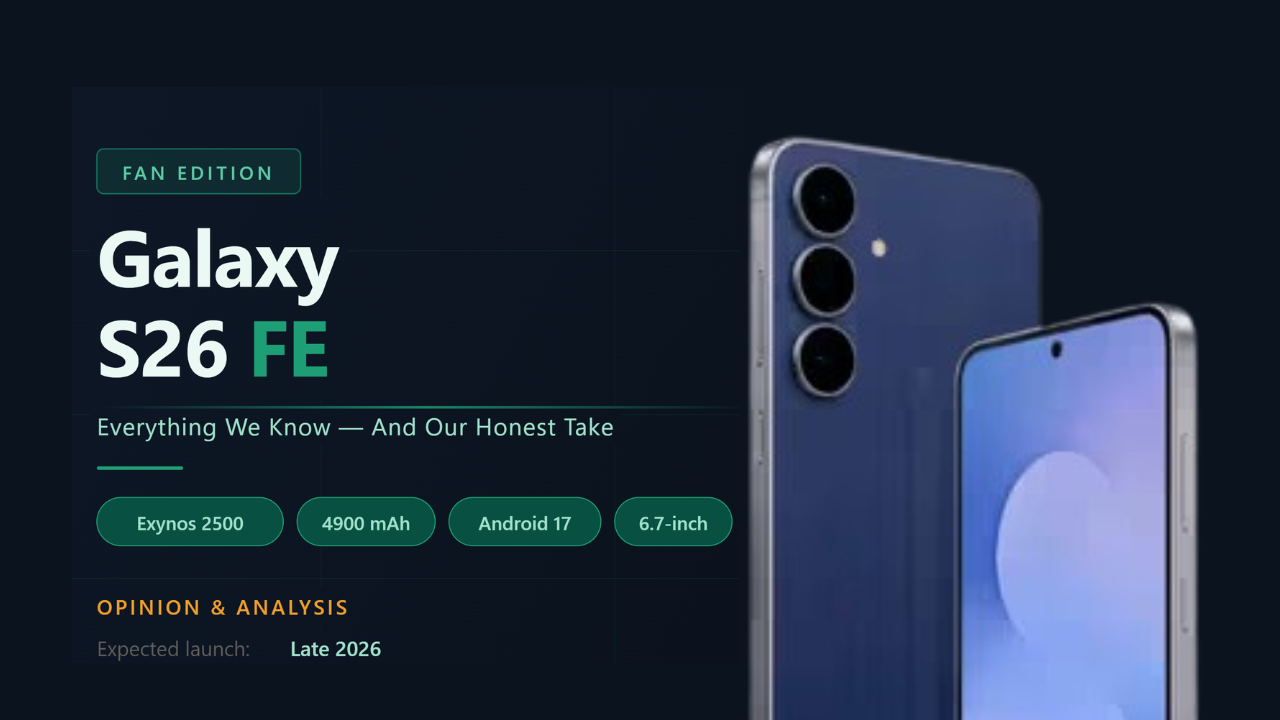
Samsung’s Fan Edition lineup has always walked a fascinating tightrope. On one side, you have buyers who desperately want a flagship Galaxy experience but can’t justify paying flagship prices. On the other, you have Samsung trying to protect the premium positioning of its main S-series. The Galaxy S26 FE, expected to arrive in late 2026, lands right in the middle of that tension — and from everything we’re hearing so far, it might just be the most interesting affordable flagship Samsung has released in years.
Let me break down what we know, what I think about it, and whether this phone deserves a spot on your shortlist.
The FE Formula: A Brief History
Before diving into the S26 FE specifically, it’s worth understanding what “Fan Edition” has actually meant over the years. When Samsung launched the Galaxy S20 FE back in 2020, it was a genuine revelation — a phone that captured roughly 80–85% of the flagship experience at a fraction of the cost. Enthusiasts loved it. Tech reviewers praised it. It sold incredibly well.
Then something shifted. The S21 FE felt late and slightly underpowered. The S23 FE was decent but uninspiring. The S24 FE received a lukewarm reception. And the S25 FE, released in September 2025 at $650, started edging into uncomfortable pricing territory — making buyers wonder why they weren’t just stretching for the standard model.
The S26 FE, then, arrives at a pivotal moment. Samsung needs to remind people why the FE exists.
What We Know About the Samsung Galaxy S26 FE So Far
Samsung has not officially announced the Galaxy S26 FE yet, but leaks and early benchmark appearances have already given us a fairly detailed picture.
Chipset: The Exynos 2500
One of the most talked-about revelations is the expected processor. The Galaxy S26 FE has reportedly been spotted on Geekbench with Samsung’s Exynos 2500 — a 10-core chip that has also been linked to the Galaxy Z Flip 7. Some earlier leaks pointed toward the Exynos 2600, suggesting Samsung may still be deciding on the final configuration, or different regions may receive different chipsets (a practice Samsung has used in the past and one that consistently frustrates buyers).
Regardless of which Exynos variant lands in the final product, the benchmark scores reportedly show a noticeable performance improvement over previous FE generations. That’s genuinely encouraging. The Exynos 2500 is no slouch, and if Samsung can pair it with proper thermal management, day-to-day performance should feel smooth and capable.
My take: The chipset decision is the make-or-break factor here. If Samsung delivers a single consistent chipset globally, that would be a massive win for consumer trust. If it splits regions again, expect the usual backlash.
RAM and Storage
Leaks point to 8GB of RAM, which is serviceable but slightly conservative in 2026. Meanwhile, storage options are expected to span 128GB, 256GB, and possibly 512GB in select markets — a configuration that mirrors what the S25 FE offered.
Honestly, 8GB RAM with a strong Exynos chip should be enough for most users doing everyday tasks, photography, and moderate multitasking. It’s not going to appeal to power users who keep 20 apps open simultaneously, but for the target audience of this phone, it’s a reasonable trade-off.
Software: Android 17 and One UI 9
The device is tipped to launch running Android 17 with One UI 9 on top. Samsung has been improving One UI significantly over recent cycles, and if the S26 FE follows the update commitment pattern of recent FE devices, buyers should expect several years of software support — a critical factor that many budget-conscious buyers overlook when choosing a phone.
Battery: Bigger Than the Standard S26
Here’s something genuinely interesting. The expected battery capacity for the S26 FE sits around 4,900 mAh, which is actually larger than the standard Galaxy S26’s 4,300 mAh. For a phone targeting value buyers — who tend to use their phones heavily without always having a charger nearby — this is exactly the right priority.
Charging is expected to remain at 45W wired, consistent with the S25 FE. It won’t win any speed records against Chinese competitors, but it gets the job done.
Display: A Bigger Screen This Time
The Galaxy S26 FE is expected to come with a 6.7-inch display at 2340 x 1080 resolution, giving it a noticeably larger screen than the standard Galaxy S26’s 6.3 inches. For users who consume a lot of media, read long articles, or just prefer a bigger canvas, this is a genuine selling point.
Whether it’s an AMOLED panel with a 120Hz refresh rate (like previous FE models) remains to be officially confirmed, but given Samsung’s track record, that seems likely.
Design: Finally Catching Up
Perhaps the most visually striking change teased by leaked case renders is the design direction. Early renders suggest the S26 FE will sport a vertical camera strip that aligns more closely with Samsung’s Galaxy A-series aesthetic. More importantly, reports suggest the overall design language feels much more premium and consistent with the broader Galaxy S26 family — rather than looking like a budget afterthought.
This matters more than many people acknowledge. Smartphones are personal items. People carry them, show them to friends, and use them for years. If the S26 FE no longer looks “cheap” at first glance, that perception shift alone could drive significantly stronger sales.
The slim bezels and punch-hole display from the S25 FE are reportedly being carried forward, which is a sensible decision.
Expected Price and Release Window
Samsung released the Galaxy S25 FE in September 2025 for $650 (128GB), and the S26 FE is widely expected to follow a late September or early October 2026 launch window — conveniently coinciding with Apple’s anticipated iPhone 18 Pro release. Samsung clearly wants to have a compelling mid-range option on shelves during the biggest smartphone shopping season of the year.
Pricing is the big question mark. If Samsung holds the line at around $649–$699, the S26 FE will look attractive. If prices creep closer to $750 or more (as happened in some markets with the S25 FE), the value proposition weakens considerably — especially given that the standard Galaxy S26 itself has already seen a price increase.
My honest opinion: Samsung needs to be disciplined here. The moment an FE phone is priced within $150 of the standard flagship, most buyers will simply wait and stretch for the real thing.
Who Is This Phone Actually For?
This is the question I always ask when evaluating a mid-range flagship. The Galaxy S26 FE, based on current leaks, seems best suited for:
- Users upgrading from a Galaxy S21 FE or S22 series who want a meaningful generational leap without paying $899 for the base S26.
- First-time Samsung buyers who want a full One UI experience, reliable software updates, and a recognizable Galaxy design at a more approachable price.
- Photography enthusiasts on a budget who value the Samsung camera ecosystem (live translate, scene optimizer, AI editing tools) over raw megapixel counts.
- People who prioritize battery life over charging speed — the bigger battery makes this phone a strong all-day performer in a way that the smaller standard S26 may not be.
It is probably not for:
- Power users or gamers who need maximum RAM and the very fastest chipset.
- Buyers who want the absolute best camera system — the S26 FE’s triple camera setup (expected to be a 50MP main, 12MP ultrawide, and 8MP telephoto) will trail the standard S26 and certainly the S26 Ultra.
- Anyone who values wireless charging speeds — Samsung FE models have historically lagged here.
How Does It Stack Up Against the Competition?
The late-2026 mid-range flagship space is getting crowded. The Google Pixel 10a, various OnePlus offerings, and a handful of Xiaomi devices are all likely to be vying for the same wallet. Samsung’s advantages are well-known: extensive retail presence, trusted brand recognition, ecosystem integration with Galaxy Watch and Galaxy Buds, and Samsung DeX support.
But the competition is genuinely catching up on software experience and camera quality. Samsung can no longer rely on brand loyalty alone. The S26 FE needs to justify its price with a tangible, everyday experience that feels worth it.
If the Exynos 2500 performs as the benchmarks suggest, the software is clean and well-supported, the design impresses in person, and Samsung prices it smartly, this could genuinely be the best FE phone since the S20 FE.
Final Thoughts: Cautiously Optimistic
I’ll be honest — I’ve been somewhat disappointed by the FE lineup over the last few product cycles. The value gap between FE and standard models has been shrinking, the design improvements haven’t always been dramatic, and Samsung’s regional chipset inconsistency has been a persistent frustration.
But the Galaxy S26 FE feels different, at least on paper. A stronger processor, a larger and arguably more practical battery, a fresher design language, and a smart launch timing all point toward a phone Samsung has actually put real thought into — rather than one assembled from leftover parts and rushed to market.
Will it be perfect? Almost certainly not. But if Samsung delivers on even 70–80% of what the leaks are suggesting, the Galaxy S26 FE could comfortably earn its place as the best mid-range Android phone of autumn 2026.
I’ll be watching the official launch very closely. And if you’re in the market for a flagship-adjacent phone later this year, so should you.